Imphal, Manipur – June 29, 2025
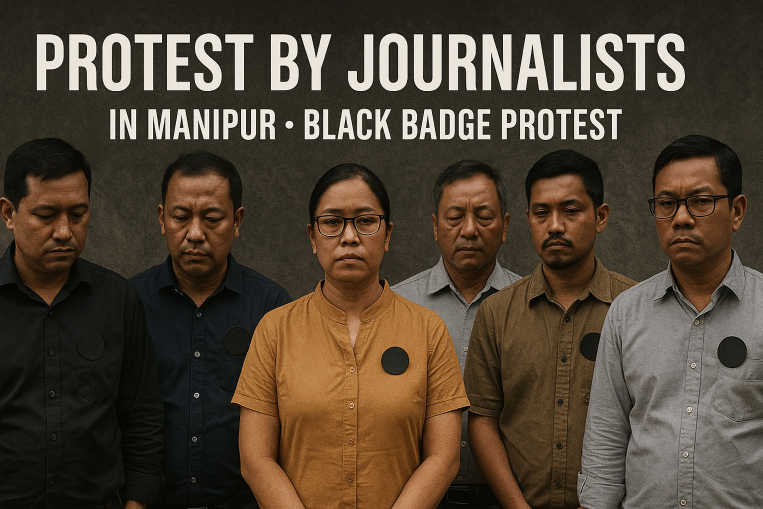
In a powerful show of resistance, journalists across Manipur are continuing their silent but determined protest against what they describe as an infringement on press freedom and their professional dignity. Members of the All Manipur Working Journalists’ Union (AMWJU) and the Editors’ Guild, Manipur, have entered the second consecutive week of their “Black Badge” protest, demanding accountability and public clarification from security forces.
At the center of this controversy lies an incident that unfolded during the Shirui Lily Festival in Ukhrul district, where a group of journalists traveling to cover the cultural celebration were allegedly stopped and questioned by security forces at Gwaltabi. Cameras were scrutinized, passes rechecked, and some journalists were reportedly made to wait for hours without justification. No violence occurred, but the treatment, according to media personnel, was “humiliating and unacceptable in a democratic society.”
🎥 What Happened at Gwaltabi?
On June 20, 2025, a convoy of accredited journalists heading to Ukhrul to cover the Shirui Lily Festival was intercepted at the Gwaltabi security checkpoint, roughly 50 kilometers from the state capital. Despite carrying valid press IDs and permissions issued by the state’s public relations office, journalists were detained for “verification” and made to submit to intrusive questioning.
The festival, revived this year after a two-year break due to regional tensions, had attracted widespread media attention for its cultural richness and efforts toward community healing. Ironically, what was meant to be a moment of cultural unity has instead reignited deep concerns over freedom of the press in Manipur.
📰 Why Journalists Are Protesting
The AMWJU and Editors’ Guild view this incident as part of a growing pattern of censorship and intimidation. In a joint statement, they condemned the “unprovoked and unjustified treatment” of media professionals who were merely doing their job.
“We wear these black badges not out of anger but out of sorrow,” said Irawat Khuman, senior journalist and protest spokesperson. “This protest is a call for dignity, for constitutional rights, and for the basic freedom to report without fear.”
While authorities later referred to the checkpoint action as a “routine verification,” journalists argue that such actions are increasingly being used to stifle independent reporting, particularly on sensitive issues involving ethnic conflict and state security operations.
🛑 The Demand for Accountability
Journalists are demanding a formal apology from the security personnel involved, public clarification from the Home Department, and most importantly, a concrete protocol for treating accredited press during conflict or sensitive situations.
According to AMWJU’s internal report, at least 18 similar incidents of press obstruction or harassment have been reported in the last 14 months in Manipur. Most of these were either dismissed or downplayed by officials. This time, however, the media fraternity seems resolute in holding the system accountable.
“We’re not asking for privilege; we’re asking for protection under the law,” said Shanta Devi, a journalist with a regional news network. “If we cannot report freely, then the truth will be the first casualty.”
🌸 The Shirui Lily Festival Overshadowed
The Shirui Lily Festival, which celebrates the rare Shirui Lily flower found only in the hills of Ukhrul, is intended to promote peace and cultural unity among Manipur’s diverse ethnic communities. The 2025 edition was meant to be a symbol of reconciliation after two years of political unrest and ethnic violence.
However, the narrative around the event has now been overshadowed by concerns over media treatment. Many social media users have come out in support of the journalists, calling for government transparency and criticizing the atmosphere of fear under which press professionals are currently working.
🧭 Political and Civil Society Reactions
Civil society groups, student unions, and rights organizations have expressed solidarity with the press. In a statement released by the Human Rights Law Network, Manipur chapter, the incident was labeled “a direct violation of Article 19 of the Indian Constitution,” which guarantees freedom of speech and expression.
Meanwhile, the state government has remained largely silent, with no official statement released from the Chief Minister’s office at the time of this writing. Sources indicate that an internal review is underway, but no disciplinary action has been announced.
🗣️ What This Protest Means for Manipur
This peaceful but highly symbolic protest is not just about one checkpoint or one festival—it represents a broader call for transparency, democratic accountability, and respect for journalistic freedom in conflict-prone regions. In a state as sensitive as Manipur—where information often travels slower than rumors—the role of a free press becomes doubly critical.
Journalists are the messengers of the people, and when those messengers are silenced or intimidated, the voice of the people itself is at risk of being muted.
🔚 Conclusion: A Press Worth Protecting
As black badges continue to be worn in newsrooms across Imphal, Ukhrul, Churachandpur, and Senapati, one message rings loud and clear: Manipur’s press will not be silenced. This ongoing protest is a reminder that democracy is not just about casting votes—it is also about holding systems accountable, asking tough questions, and defending the truth when it’s hardest to do so.
Whether the state listens remains to be seen. But the journalists of Manipur have spoken—with courage, with restraint, and with black badges pinned close to their hearts.