


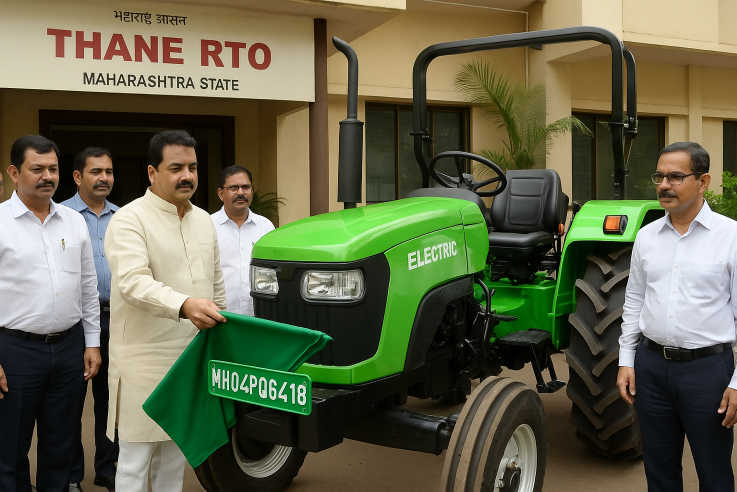
In a landmark moment for India’s agricultural sector, Maharashtra has officially registered its first electric tractor, symbolizing a decisive step toward cleaner, more sustainable farming. The inauguration took place at the Thane Regional Transport Office (RTO), where State Transport Minister Pratap Sarnaik introduced the 45-horsepower electric vehicle, drawing attention from both agricultural and environmental sectors alike.
⚙️ The First of Its Kind in the State
The electric tractor—developed with cutting-edge technology—has been designed to significantly reduce operational costs and environmental impact. This pioneering vehicle not only runs without diesel but also offers low maintenance, zero tailpipe emissions, and quieter operation, making it a viable alternative for India’s agrarian communities.
It is especially relevant in a state like Maharashtra, where agriculture continues to be a backbone of the economy. Farmers across districts, from Vidarbha to Marathwada, are expected to benefit from this revolutionary shift in mechanization.
🚜 Minister Pratap Sarnaik’s Vision
Speaking at the launch event, Minister Sarnaik said,
“This is not just a registration of a vehicle—it is a registration of hope, innovation, and the future. Electric farming equipment will empower our farmers with cleaner, cost-efficient tools while also protecting the environment.”
The Minister further emphasized the state’s commitment to green energy, citing upcoming policies that will subsidize electric tractors and offer infrastructure support such as solar charging stations in rural areas.
💡 Why Electric Tractors Matter
India has been grappling with rising fuel prices, air pollution, and climate change. The adoption of electric tractors provides a three-fold solution:
- Cost-Effective: Electric tractors dramatically lower fuel and maintenance costs, increasing farmers’ net income.
- Eco-Friendly: They reduce greenhouse gas emissions, contributing to the global fight against climate change.
- Technologically Advanced: These tractors come equipped with smart features, including GPS-based precision farming capabilities.
Approximately 6% of traditional agricultural equipment in India may be replaced by electric variants over the next five years, experts suggest. This transition is gaining speed, particularly in Maharashtra, due to increasing governmental support and awareness.
🔋 Features of the Electric Tractor
The newly registered electric tractor features:
- 45 HP Power Output
- Battery Life of 6–8 Hours
- Fast Charging in Under 4 Hours
- Hydraulic Lift Capacity of 1800–2000 kg
- Digital Dashboard and Telematics for Smart Monitoring
It is built to handle all routine agricultural activities including tilling, ploughing, sowing, and hauling. The absence of diesel and engine oil also makes it environmentally cleaner and easier to maintain.
🌿 A Step Toward Green Farming in India
India’s farming community is now at a crossroads where tradition meets technology. While diesel-powered tractors have been the norm for decades, the climate and cost-related challenges they pose can no longer be ignored.
The government’s push for electric mobility, especially in the agriculture sector, aligns with broader initiatives like:
- Faster Adoption and Manufacturing of Hybrid and Electric Vehicles (FAME) Scheme
- National Electric Mobility Mission Plan (NEMMP)
- Solar Energy Subsidy Programs for Farmers
📈 Future Outlook
The Thane RTO’s registration is expected to pave the way for mass adoption. Already, several farmers’ cooperatives and agri-tech startups have shown interest in leasing and financing these electric tractors. A few are even exploring solar charging stations to make them entirely off-grid.
Local RTOs across Maharashtra are now being trained to facilitate faster approvals for such green vehicles, and similar launches are scheduled in districts like Nashik, Pune, and Aurangabad.
🔚 Conclusion
The registration of Maharashtra’s first electric tractor is more than a technological upgrade—it’s a symbol of transformation. As the state embraces electric mobility, farmers stand to gain economically, while the environment receives a long-overdue reprieve.
Innovation has arrived at the farm gates, and the green revolution of the 21st century may very well be driven—not by diesel—but by electricity.