


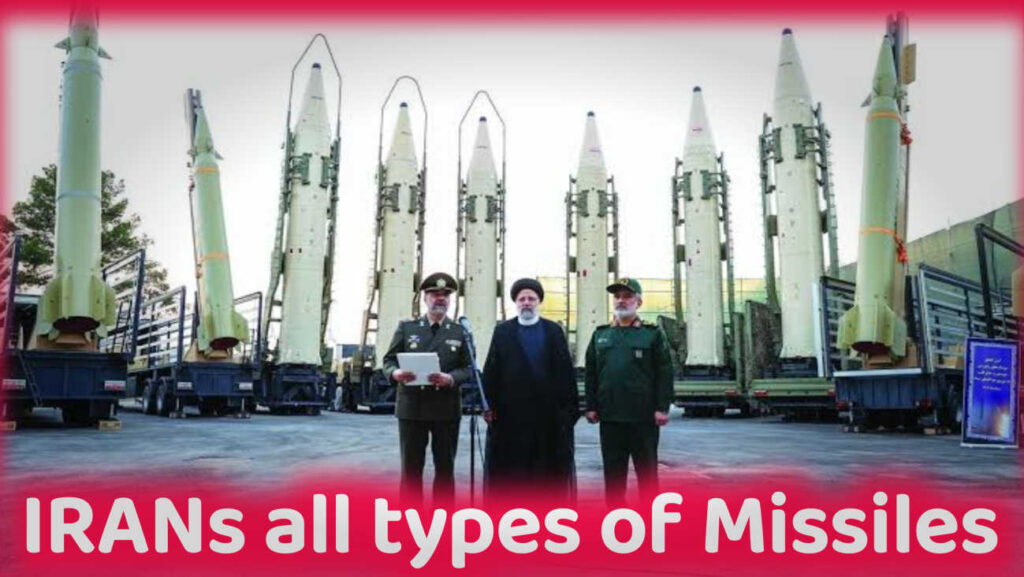
All Types of Missiles
Iran, a powerful country in the Middle East, is well known for its missile program. Over the past two decades, Iran has developed a wide range of missiles, both for defense and as a show of strength. These missiles vary in range, design, speed, and purpose—some are made for short-range battles, while others can travel across countries. Let’s take a detailed look at the different types of missiles Iran has in its growing collection.
🎯 1. Short-Range Ballistic Missiles (SRBMs)
These missiles can travel up to 1,000 kilometers. They are used for close-range attacks, near attack, especially in nearby regions like the Persian Gulf, Iraq, or parts of the Middle East. Iran has many types of SRBMs, and they are considered highly reliable and best capable.
Common SRBMs in Iran’s Arsenal:
- Fateh-110: A solid-fuel missile with high accuracy and a range of about 300 km.
- Zolfaghar: Improved version of Fateh-110, with a range of around 700 km.
- Dezful: Another upgraded SRBM with a range of 1,000 km.
- Qiam-1: A liquid-fuel missile developed from Scud technology.
These missiles are often used in regional conflicts and by Iran’s allied groups in Iraq, Syria, and Lebanon.
🚀 2. Medium-Range Ballistic Missiles (MRBMs)
These missiles can travel between 1,000 and 3,000 kilometers, making them capable of hitting targets in Israel, Saudi Arabia, and parts of Europe.Especially nowadays used in Iran-Israel Conflict.
Notable MRBMs:
- Shahab-3: One of Iran’s oldest MRBMs with a range of around 1,300 km.
- Emad: An upgraded Shahab missile with better accuracy and a heavier warhead.
- Ghadr-110: A lighter and faster missile with a range of 2,000 km.
- Sejjil-2: A solid-fuel, two-stage MRBM with better speed and launch time.
- Jihad Missile: Introduced in 2024, said to have speeds up to Mach 8 and a range of 1,000 km.
- Etemad Missile: Revealed in early 2025, with an impressive 1,700 km range.
These MRBMs are seen as Iran’s most powerful tools in case of long-range conflict.
🛫 3. Long-Range Missiles (IRBMs & ICBMs – Under Development)
Iran does not officially claim to have intercontinental ballistic missiles (ICBMs) yet, which are missiles that can travel over 5,500 km. However, some of its designs are getting close to that capability, and Western nations have expressed concern.
Iran has tested space launch vehicles, such as the Simorgh and Safir, which use similar technology to ICBMs. These developments suggest Iran is getting closer to building missiles that can reach Western Europe or even farther.
🌪️ 4. Hypersonic Missiles
In 2023 and 2024, Iran shocked the world by unveiling its hypersonic missile, known as Fattah. Hypersonic missiles are extremely fast, flying at speeds greater than Mach 5 (five times the speed of sound), and are very hard to intercept.
Key Features of Fattah:
- Speed: Over Mach 13
- Range: Around 1,400 km
- Fuel: Solid fuel
- Can bypass missile defense systems
This development places Iran among a small group of countries with hypersonic missile technology.With hight precision and high speed on target.
🧨 5. Cruise Missiles
Unlike ballistic missiles that fly into space before hitting the target, cruise missiles fly at lower altitudes, making them harder to detect. Iran’s cruise missiles are becoming more advanced and are mainly used for precision strikes and unditectable attack.
Major Cruise Missiles:
- Soumar: Based on Russian technology, with a long range (up to 2,000 km).
- Hoveyzeh: Another long-range cruise missile capable of flying low and hitting targets with high accuracy.
- Nasr and Noor: Shorter-range missiles used in naval operations.
Iran also mounts some of these on ships and submarines.
🔁 6. Drones with Missile Technology
Iran has been combining missile and drone technologies. Some of its drones can now launch guided missiles or explode on impact. Models like Shahed-136 and Mohajer-6 are increasingly used in regional conflicts. Nowadays Iran among the few countries with high drones stocks and capable of making in low cost. Several drones all used by Russia in Ukrainie
🛡️ Summarise
Iran’s missile program is massive, diverse, constantly evolving and huge stocks. From short-range rockets to powerful medium-range weapons and now hypersonic systems of missile, the country has built one of the most feared missile arsenals in the region. These missiles serve multiple purposes—defense, deterrence, and influence across the Middle East and beyond.
While global powers watch with concern, Iran continues to test and showcase new missile types, signaling that its ambitions in defense technology is indicating despite of several sanctions they can stand firm.